
- Home
- /
- Products & Services
- /
- Infrastructure - Related Products
- /
- Flexible Cables
Flexible Cables
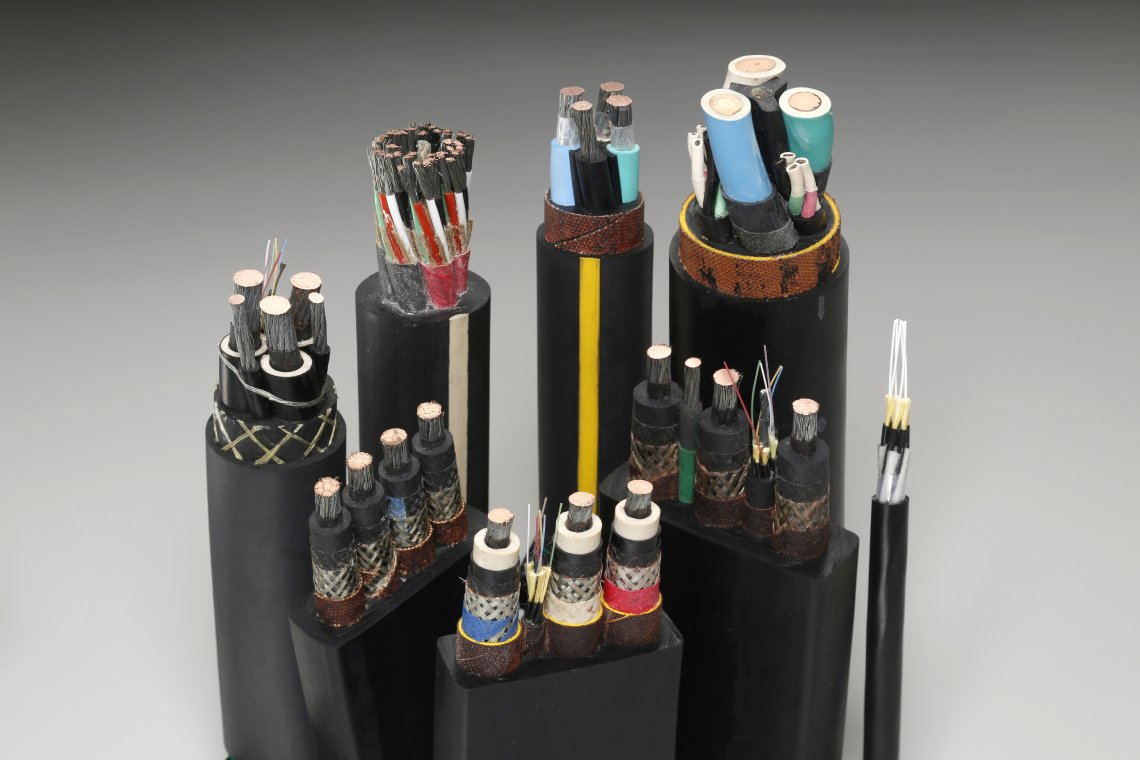
DESCRIPTION
Cables with superior flexibility are used to supply power and signals to cranes and hoists inside plants (supplemental equipment for cranes). Since they are also durable enough to be used in harsh environments, these cables are expected to play a role in mining and other areas of the resource extraction sector.
Application:
A flexible cable is used in crane and hoist systems where power and signal transmission must remain stable during repeated movement. In festoon and chain applications, the cable bends and travels along the crane path as the equipment moves. In carrier drum systems, the cable is guided around drums as the equipment travels, helping manage cable movement across longer operating paths.
For lift, torsion, moving pulley, and reel systems, the cable must also withstand vertical movement, twisting, winding, and unwinding without interrupting operation. These applications are commonly found in plants, cranes, hoists, and other heavy-duty environments where equipment moves continuously. With its flexibility and durability, flexible cables can support reliable performance in demanding settings, including mining and resource extraction operations.

Certifications and Compliance
Our flexible cables meet IEC 60227 and IEC 60245 standards, supporting safe and reliable use across crane, hoist, reel, festoon, carrier drum, and moving pulley applications. These standards cover key requirements for PVC-insulated and rubber-insulated cables, helping ensure suitable electrical performance, insulation quality, and durability for moving equipment.
RELCT SERIES
The RELCT Series is designed for reeling cable applications. It includes RELCT (MV) with a rated voltage of 6/10 kV and RELCT (LV) with a rated voltage of 0.6/1 kV. Both options are rated for operating temperatures up to 90°C.
Key benefits of the RELCT Series include:
- Stable power transmission during repeated winding and unwinding
- Suitability for mobile equipment
- Useful in demanding industrial environments
| System Application | Type of Cable | Rating Voltage | Rating Temp. | Product Specifications |
|---|---|---|---|---|
| Reeling Cable | RELCT (MV) | 6/10 kV | 90°C | - |
| RELCT (LV) | 0.6/1 kV |
SPDCT SERIES
The SPDCT Series is designed for spreader cable applications, such as basket-type systems used in moving equipment and container-handling operations. The series includes SPDCT and SPDCT (Y) with a rated voltage of 600 V, as well as SPDCT (RE) with a rated voltage of 0.6/1 kV. These cables are rated for operating temperatures up to 80°C.
Key benefits of the SPDCT Series include:
- Flexibility during repeated movement
- Stable power and signal transmission
- Consistent support for spreader systems that require dependable cable performance
| System Application | Type of Cable | Rating Voltage | Rating Temp. | Product Specifications |
|---|---|---|---|---|
|
Spreader Cable (Basket Type) |
SPDCT | 600 V | 80°C | - |
| SPDCT (Y) | ||||
| SPDCT (RE) | 0.6/1 KV |
FTNCT SERIES
The FTNCT Series is designed for festoon cable and chain cable applications. It includes FTNCT, FTNCT-SB, FTNCT-PSB, and FRCCT, with a rated voltage of 0.6/1 kV and an operating temperature of up to 90°C. For carrier drum cable applications, CARCT is available with a rated voltage of 600 V and an operating temperature of up to 80°C.
Key benefits of the FTNCT Series include:
- Stable power and signal transmission
- Ability to support continuous movement along festoon or cable chain systems
- Versatility based on equipment layout, bending requirements, voltage needs, and operating conditions
| System Application | Type of Cable | Rating Voltage | Rating Temp. | Product Specifications |
|---|---|---|---|---|
|
Festoon Cable & Chain Cable |
FTNCT | 0.6/1 KV | 90°C | - |
| FTNCT-SB FTNCT-PSB |
||||
| FRCCT | ||||
| Carrier Drum Cable | CARCT | 600 V | 80°C | - |
FFCT SERIES
Designed for heat resistant flexible cable applications, the FFCT Series includes FFCT and FFCTB. These cables feature a rated voltage of 600 V and an operating temperature of up to 200°C.
Key benefits of the FFCT Series include:
- Heat resistance
- Flexibility during equipment movement
- Reliable power transmission in demanding industrial settings
| System Application | Type of Cable | Rating Voltage | Rating Temp. | Product Specifications |
|---|---|---|---|---|
| Heat Resistant Flexible Cable |
FFCT | 600 V | 200°C | - |
| FFCTB |
Frequently Asked Questions
What are flexible cables used for?
Flexible cables are used in equipment that moves repeatedly during operation, such as cranes, hoists, reels, festoon systems, carrier drums, and moving pulleys. They help transmit power and signals while allowing the cable to bend, travel, wind, or twist with the equipment. Working with a reliable machining part manufacturer can help businesses source cable solutions that match the movement, voltage, and operating conditions of their equipment.
How are flexible cables different from standard cables?
Flexible cables are designed to handle repeated movement, bending, and mechanical stress. Compared with standard fixed cables, they are more suitable for moving systems used in plants, ports, mining sites, and infrastructure products.
Which industries use flexible cables?
These cables are used across industrial sectors where moving equipment must operate reliably. These may include crane systems, automotive products, and heavy equipment applications.
Can flexible cables support electronics-related applications?
Yes. They can support power and signal transmission in applications where stable connectivity is needed during movement. This can be relevant for electronic part manufacturers and equipment systems that require consistent performance under repeated motion.
How do I choose the right flexible cable?
The right flexible cable depends on the application, voltage rating, operating temperature, movement pattern, bending requirement, and working environment. For assistance with cable selection, contact us to discuss your equipment requirements.
 Proterial Asia